Founder, SEOcalibre · 23 min read · AI Search
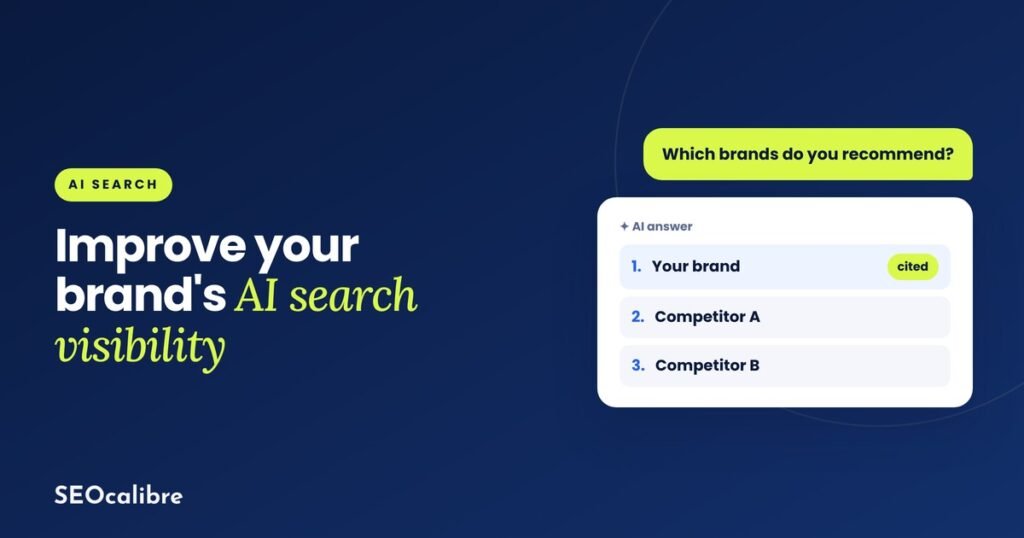
When someone asks ChatGPT to recommend a software platform, searches Google for the best service provider or uses Perplexity to compare products, does your brand appear in the answer?
For many businesses, this is becoming an important question.
People are increasingly using AI-powered search experiences to research products, explore solutions, compare companies and find answers. Instead of navigating through a list of ten blue links, they may receive a summarized response that references a handful of sources and brands.
That changes how businesses need to think about online visibility.
Traditional SEO focuses heavily on helping websites appear in search results. AI search visibility adds another consideration: whether your brand, expertise and content are discovered, understood, referenced or recommended within AI-generated responses.
But improving that visibility is not as simple as adding a few FAQs, publishing AI-generated articles or inserting structured data into a website.
It requires a broader approach involving technical accessibility, useful content, clear brand information, credible external references and consistent measurement.
This guide explains how to improve your brand’s visibility across Google AI Overviews, ChatGPT, Perplexity and other AI-powered search experiences, with practical steps you can apply to your website and broader digital presence.
Key takeaways: AI search visibility goes beyond ranking webpages. It focuses on how AI systems discover, understand and represent your brand across platforms such as Google AI Overviews, ChatGPT and Perplexity. Build on traditional SEO, create clear and useful content, strengthen your brand entity, earn credible third-party references and maintain technical accessibility. Track brand mentions, citations, cited pages and competitor visibility, while recognizing that no SEO or GEO agency can guarantee AI recommendations or citations.
What Is AI Search Visibility?
AI search visibility refers to how frequently and in what context a brand, business, product or website appears in AI-powered search experiences.
These experiences include:
- Google’s AI Overviews and AI Mode.
- ChatGPT search.
- Perplexity.
- Microsoft Copilot.
- Other AI-powered search and answer platforms.
Consider someone looking for a CRM platform for a small business.
They might ask Google for the best CRM software, request a shortlist from ChatGPT or use Perplexity to compare several products.
The resulting answer may mention specific brands, describe their features, compare their suitability and link to supporting websites.
A company that appears in these responses gains an additional opportunity to be discovered. A competitor that is consistently absent may miss some of that consideration, even if its website performs reasonably well in traditional search.
AI search visibility can take several forms:
| Visibility type | What it means |
|---|---|
| Brand mention | Your company or product is named in an AI-generated response |
| Source citation | Your website is linked or referenced as a supporting source |
| Product recommendation | Your product is suggested for a particular use case |
| Information retrieval | Content from your website is used to answer a question |
| Brand comparison | Your business appears alongside competing brands |
| Entity recognition | The system accurately understands your company, products and relationships |
These are related, but they are not interchangeable. A brand mention does not necessarily mean that the company’s website was cited. Similarly, a webpage citation does not always mean that the brand received a direct recommendation.
For that reason, businesses should look beyond a single AI visibility score.
SEO, AEO and GEO: Understanding the Difference
AI search optimization is often discussed using three terms: SEO, AEO and GEO.
They overlap, but each describes a different aspect of search visibility.
| Approach | Meaning | Main objective |
|---|---|---|
| SEO | Search Engine Optimization | Improve visibility in traditional search results |
| AEO | Answer Engine Optimization | Make useful information easier to retrieve and present in answer-based experiences |
| GEO | Generative Engine Optimization | Improve a brand’s visibility in generative AI responses |
Search Engine Optimization (SEO) focuses on improving a website’s discoverability, relevance, technical accessibility and authority in search engines.
Answer Engine Optimization (AEO) focuses on making information clear and useful for systems that respond directly to questions. This includes conversational answers, concise explanations and well-organized information.
Generative Engine Optimization (GEO) focuses on improving how brands and their content are discovered, interpreted, referenced and represented in AI-generated responses.
For example, a healthcare software company may use SEO to improve its visibility for relevant software searches, AEO to provide clear answers about its product capabilities and GEO to strengthen the likelihood of being considered in AI-generated comparisons.
These activities should not be treated as completely separate marketing disciplines.
Google has stated that its AI search features continue to rely on established Search foundations. Its guidance emphasizes useful content, technical accessibility and established SEO practices rather than a separate set of guaranteed AI-ranking tricks.
The practical takeaway is that AI search optimization should build on a strong SEO foundation.
How AI Search Platforms Discover and Reference Brands
Different AI platforms use different systems, data sources and retrieval methods. There is no single process that determines whether a brand appears everywhere.
However, understanding the broad mechanisms helps explain where optimization efforts should focus.
Search-based retrieval
Some AI experiences retrieve information from web search indexes or other searchable sources when generating a response.
For example, Google’s AI features can use its Search systems to identify relevant information and provide links to supporting pages.
ChatGPT search can retrieve information from the web and provide links to relevant sources. Perplexity also presents answers with supporting citations.
This makes discoverability important. If relevant website content cannot be accessed, indexed or retrieved, it may have fewer opportunities to appear as a supporting source.
Content interpretation
After retrieving information, AI systems need to understand what it says.
A page that clearly explains a product’s purpose, features, audience and limitations is easier to interpret than one filled with vague marketing language.
Compare these two descriptions:
- “A next-generation platform transforming business productivity.”
- “A project management platform that helps marketing teams assign tasks, track deadlines and manage campaign workflows.”
The second description communicates a more specific product category, audience and use case.
Clarity matters because AI-generated responses need information that can be interpreted and connected to a user’s question.
Brand and entity understanding
AI systems may encounter information about a company across its website, industry publications, product directories, review platforms and other sources.
Consistent information makes it easier to establish that these references describe the same business.
For example, if a software company is described as an accounting platform on its website, a payroll tool in a directory and a financial consulting company in another profile, the conflicting descriptions may create ambiguity.
Clear entity information helps establish what the business is, what it offers and whom it serves.
Source evaluation and response generation
AI systems do not simply reproduce every retrieved webpage.
They select, combine and present information based on their own systems and relevance signals. The exact selection process varies by platform and is not fully public.
A brand can have excellent website content and still not appear in a particular response.
This is why AI search visibility should be treated as an ongoing optimization and measurement process rather than a one-time technical implementation.
The Five-Layer Framework for Improving AI Search Visibility
A practical AI search strategy can be organized into five connected areas:
- Discoverability
- Content clarity
- Entity consistency
- Authority and evidence
- Measurement and improvement
Each layer addresses a different visibility challenge.
1. Improve Your Website’s Discoverability
Before focusing on AI citations or brand recommendations, make sure your important website content can actually be discovered.
This starts with technical SEO.
AI-powered search systems may use web crawlers, search indexes, retrieval systems and other sources to access information. If important pages are blocked, inaccessible or difficult to interpret, they may have fewer opportunities to be considered.
Start with these checks.
Review search engine indexability
Make sure important pages are eligible for search indexing.
Check:
- Robots.txt restrictions.
- Meta robots directives.
- Canonical tags.
- XML sitemaps.
- Redirect chains.
- Broken internal links.
- Unintentionally blocked resources.
Use Google Search Console to review indexing and identify technical problems.
Check AI crawler access
Different AI services use different crawlers and access controls.
For example, OpenAI documents separate crawler user agents for search discovery and model training. OAI-SearchBot is used for ChatGPT search discovery, while GPTBot relates to content that may be used for training.
If you want your website to be discoverable in ChatGPT search, review your robots.txt rules and hosting or CDN configuration to ensure OAI-SearchBot is not unintentionally blocked.
Similarly, review the relevant documentation for other platforms rather than assuming that allowing one crawler automatically enables access everywhere.
Do not change crawler permissions without understanding the implications for your content and business.
Make important information accessible in text
Product descriptions, service details, technical documentation and important answers should be available as readable website content.
Images, videos and interactive elements can support the experience, but essential information should not exist only inside an image or inaccessible interface.
For JavaScript-heavy websites, verify that important content can be rendered and accessed by search engines.
Maintain a clear internal linking structure
Important pages should be reachable through relevant internal links.
Connect:
- Product pages to feature pages.
- Service pages to relevant industry resources.
- Educational guides to related solutions.
- Comparison pages to product details.
- Company information to relevant business and contact pages.
This helps users navigate your website and supports the discovery of important content.
2. Create Content That AI Systems and People Can Understand
Content quality remains central to AI search visibility.
However, simply writing short answers or adding question-based headings does not automatically make a page suitable for AI-generated responses.
The objective is to publish information that directly addresses user needs and provides enough context to be useful.
Answer questions clearly
Start by identifying the questions people ask about your industry, products and services.
For a cybersecurity company, these might include:
- What is endpoint detection and response?
- How does managed detection and response work?
- What is the difference between EDR and XDR?
- Which cybersecurity solution is suitable for a small business?
Each question represents a different information need.
Create content that addresses the question directly before expanding into the explanation.
For example:
What is endpoint detection and response?
Endpoint detection and response (EDR) is a cybersecurity technology that monitors endpoint devices, detects suspicious activity and helps security teams investigate and respond to potential threats.
The article can then explain how EDR works, its main capabilities, implementation considerations and how it differs from other security solutions.
This structure provides a clear answer without sacrificing depth.
Use descriptive headings
Headings should tell readers what each section actually covers.
Instead of using vague headings such as:
- Our Approach
- Why It Matters
- The Future
Use more descriptive alternatives:
- How Endpoint Detection and Response Works
- Benefits of EDR for Small Businesses
- EDR vs XDR: Key Differences
Descriptive headings make content easier to navigate and provide clearer context for individual sections.
Support claims with evidence
Avoid relying on generic statements such as “our solution is the best” or “businesses achieve better results with our platform.”
Explain what makes the product different.
Where possible, support claims with:
- Original research.
- Product demonstrations.
- Customer case studies.
- Verified performance data.
- Expert commentary.
- Relevant industry references.
- Technical documentation.
For example, a project management company could publish original research on common project delivery challenges based on its own customer data, provided the methodology and limitations are explained.
Original information gives readers something more valuable than another rewritten explanation of an existing topic.
Keep content specific and complete
Avoid producing multiple pages that repeat the same information with slightly different wording.
A useful article should answer the main question, explain relevant concepts, address important limitations and provide practical next steps.
The goal is not to create content that sounds optimized for an AI system. It is to create content that is genuinely useful when a person or information retrieval system encounters it.
3. Strengthen Your Brand Entity and Online Identity
Entity SEO is an important part of building a consistent digital presence.
An entity is a distinct, identifiable subject, such as a company, person, product, organization or location.
For a business, entity clarity means making it easy to understand:
- What the company is.
- Which industry it operates in.
- What products or services it offers.
- Which audiences it serves.
- What makes it distinct.
- How it relates to other businesses, products and organizations.
Consider a company that provides international SEO services.
Its website should clearly explain that it is an SEO agency, describe its service offerings, identify its target markets and provide consistent business information.
If the same company appears across business directories, professional profiles and industry publications, those descriptions should reinforce rather than contradict its website.
Build a consistent company identity
Review the following information across your digital presence:
| Information | What to maintain |
|---|---|
| Business name | Consistent official name |
| Website | Primary business domain |
| Description | Clear explanation of the company |
| Industry | Accurate business category |
| Services | Consistent service descriptions |
| Products | Accurate product names and capabilities |
| Location | Correct business location information |
| Leadership | Accurate and relevant professional information |
This does not mean every platform needs identical wording. Descriptions can be adapted to the platform, but the underlying facts should remain consistent.
Use structured data appropriately
Structured data helps describe information on a webpage in a machine-readable format.
Depending on the business and page, relevant Schema.org types may include:
- Organization.
- LocalBusiness, when applicable.
- Product.
- SoftwareApplication.
- Article.
- Person.
- BreadcrumbList.
For example, a software company may use appropriate SoftwareApplication markup to describe its application, provided the information accurately reflects the visible page content.
Structured data should not be treated as a shortcut to AI citations. Google has explicitly stated that there is no special schema markup required to appear in AI Overviews or AI Mode.
Use schema to describe real information accurately, not to manufacture signals that are not supported by the page.
Develop a stronger brand knowledge footprint
Your website is only one part of your brand’s digital identity.
Relevant references may also exist across:
- Industry publications.
- Professional directories.
- Product listing platforms.
- Review websites.
- Partner websites.
- Professional profiles.
- Industry associations.
- Credible media coverage.
The objective is to create an accurate, recognizable and consistent representation of the business across relevant sources.
Do not create profiles everywhere simply to increase the number of listings. Prioritize platforms that genuinely matter to your industry and customers.
4. Build Authority Through Credible Mentions and References
A brand’s wider online reputation can influence how it is discovered and understood.
When relevant publications, industry experts, partners and customers discuss a business, they provide additional context about its products, expertise and market position.
This makes authority building an important part of generative engine optimization.
Earn relevant industry mentions
Focus on earning references from sources that have a genuine connection to your industry.
Examples include:
- Industry publications.
- Relevant software directories.
- Professional associations.
- Research websites.
- Business partners.
- Subject-matter experts.
- Established review platforms.
A cybersecurity company may benefit from being referenced in cybersecurity publications. A SaaS product may gain useful exposure through relevant software directories and integration partners.
Relevance and credibility matter more than collecting a large number of unrelated mentions.
Publish original research and useful resources
One of the strongest ways to earn references is to create something worth referencing.
Consider publishing:
- Industry reports.
- Original surveys.
- Data-driven research.
- Practical calculators.
- Templates and checklists.
- Product comparison resources.
- Technical guides.
For example, an HR software company could publish a report examining employee onboarding challenges across different business sizes.
If the research contains meaningful findings, clear methodology and useful insights, other industry websites may reference it.
This can create both traditional SEO value and opportunities for wider brand discovery.
Encourage genuine customer reviews
Reviews can help potential customers evaluate a business and understand its reputation.
Maintain accurate profiles on relevant review platforms and encourage genuine customers to share their experiences.
Do not purchase reviews, manufacture testimonials or pressure customers into publishing positive feedback.
The aim is to build a trustworthy reputation, not to create artificial popularity.
Build authority without chasing unlinked mentions
A brand mention without a hyperlink may still provide context about the company, but its exact influence on any particular AI system is difficult to establish.
Do not treat every unlinked mention as a measurable ranking signal.
Instead, focus on earning meaningful references and maintaining consistent information wherever your brand is discussed.
5. Optimize Your Brand for Specific AI Search Experiences
Different platforms provide different discovery experiences. A strategy should account for those differences without creating separate, disconnected SEO programs.
Improve visibility in Google AI Overviews and AI Mode
Google’s AI search experiences build on its broader Search systems.
The practical priorities include:
- Ensure important pages are indexed and eligible to appear in Search.
- Publish useful, original content.
- Use clear page structures and descriptive headings.
- Make important information accessible as text.
- Maintain accurate structured data.
- Improve internal linking and technical accessibility.
- Support relevant content with useful images and videos.
There is no separate AI Overview schema or guaranteed optimization technique.
Focus on satisfying search intent and creating content that provides a reason for users to visit your website.
Improve your visibility in ChatGPT
ChatGPT search can surface public websites and provide links to sources.
For website owners, an important technical consideration is allowing OAI-SearchBot to access pages intended for discovery through ChatGPT search.
Beyond crawler access:
- Maintain accurate product and service information.
- Publish detailed explanations of your offerings.
- Make important content easy to discover.
- Build credible external references.
- Keep factual information current.
Test relevant prompts to understand whether your business is mentioned, which competitors appear and which sources are cited.
Remember that appearing in one ChatGPT response does not guarantee visibility in another. Results can vary depending on the query and context.
Improve your visibility in Perplexity
Perplexity presents answers with supporting sources, making cited references an important part of the user experience.
Focus on creating content that provides useful, verifiable information.
This includes:
- Original research.
- Clear explanations.
- Accurate technical information.
- Relevant industry resources.
- Well-maintained product documentation.
- Credible external references.
Review whether your website appears among the cited sources for questions that matter to your audience.
Do not assume that a page’s appearance in Google automatically means it will be cited by Perplexity.
Consider Microsoft Copilot and other AI experiences
Microsoft Bing’s webmaster guidance is relevant to visibility across Bing-powered search and Copilot experiences.
Maintain strong technical SEO, provide focused and useful content, consolidate duplicate URLs and ensure important information is accessible.
The broader lesson applies across AI search platforms: clear, original and technically accessible information provides a stronger foundation than platform-specific shortcuts.
6. Measure AI Search Visibility Instead of Guessing
One of the biggest challenges in AI search optimization is measurement.
Traditional SEO provides established metrics such as impressions, clicks, rankings and organic conversions.
AI search requires additional observation because a brand can appear in an answer without receiving a website visit.
A useful measurement process should track several dimensions.
| Metric | What to monitor |
|---|---|
| Brand mentions | How frequently your brand appears in relevant AI responses |
| Citation frequency | How often your website is cited as a source |
| Cited pages | Which URLs are referenced |
| Competitor visibility | Which competing brands appear in the same answers |
| Share of voice | Your brand’s presence relative to selected competitors |
| Sentiment and accuracy | Whether AI responses describe your business correctly |
| Referral traffic | Visits arriving from AI platforms |
| Conversions | Leads, enquiries or sales associated with those visits |
Create a consistent prompt tracking process
Start by building a set of questions that reflect how customers discover and evaluate businesses.
For example, a company offering project management software could monitor:
- What are the best project management tools for marketing agencies?
- Which project management platforms are suitable for small businesses?
- What are the alternatives to Product A?
- Which tools support automated project reporting?
- How does Product A compare with Product B?
Group prompts by:
- Industry.
- Product category.
- Use case.
- Problem.
- Comparison.
- Purchase intent.
Run the same prompts periodically across the platforms relevant to your audience.
Record:
- Whether your brand appeared.
- Whether your website was cited.
- Which competitors appeared.
- Which sources were referenced.
- Whether the product information was accurate.
- Whether the answer presented your brand positively, neutrally or negatively.
Because AI responses can change, avoid treating a single test as conclusive evidence.
Use consistent prompts, record the platform and date, and compare results over time.
Connect AI visibility with website analytics
AI mentions are useful observations, but they should not be the only measure of success.
Use analytics tools to review referral traffic from AI platforms where identifiable. Combine this with Search Console data, website conversions and CRM records.
For example, if an AI platform sends visitors to a particular product page, examine whether those visitors explore the product, request a demo or start a trial.
This helps connect AI search visibility with actual business outcomes.
7. Common AI Search Optimization Mistakes
AI search is a developing area, and many optimization claims are presented with more certainty than the available evidence supports.
Avoid these common mistakes.
Treating GEO as a replacement for SEO. Traditional search visibility and technical foundations continue to matter across many AI-powered search experiences.
Publishing content just to target AI prompts. Creating dozens of nearly identical articles around question variations does not automatically improve visibility.
Adding schema without a clear purpose. Structured data should accurately describe visible page content. It is not a guarantee of AI citations.
Assuming llms.txt is essential. Some websites experiment with AI-specific text files, but Google does not require them for inclusion in AI Overviews or AI Mode. Do not treat them as a substitute for crawlability, indexing and useful content.
Blocking relevant AI crawlers accidentally. Review crawler access and make deliberate decisions about which services should access your public content.
Buying artificial brand mentions. Manipulated reviews, fabricated citations and irrelevant placements can undermine credibility.
Ignoring brand accuracy. Inconsistent product descriptions, outdated business profiles and conflicting company information can create confusion.
Measuring only AI mentions. A brand mention without relevant traffic, qualified interest or business impact is not a complete measure of success.
The best approach is to prioritize genuine usefulness, technical accessibility and credible brand development.
8. How to Choose an AI SEO, AEO or GEO Agency
Businesses that want specialist support may consider AI SEO services, AEO services or GEO services.
However, the terminology alone does not tell you whether an agency has a sound strategy.
Before choosing an AEO agency or GEO agency, evaluate its approach.
Does it understand traditional SEO?
AI search visibility still depends on important foundations such as crawlability, indexing, content quality and website structure.
Can it explain its methodology?
The agency should be able to explain how it researches queries, reviews competitors, improves content, strengthens brand entities and monitors AI visibility.
Does it understand your industry?
A strategy for a SaaS company may differ from one for a healthcare provider, financial services business or ecommerce brand.
Does it measure more than rankings?
Ask whether its reporting includes brand mentions, citations, cited pages, competitor comparisons and relevant website conversions.
Does it avoid unrealistic promises?
Be cautious of guarantees such as first-page ChatGPT rankings, guaranteed AI citations or guaranteed recommendations across every AI platform.
No agency controls how an AI system generates an answer.
A credible AI search optimization services provider should offer a transparent process, explain its limitations and connect its work to measurable business objectives.
9. A Practical AI Search Visibility Roadmap
Improving AI search visibility is an ongoing process. The following roadmap provides a structured starting point.
| Phase | Main activities | Expected outcome |
|---|---|---|
| Audit | Review SEO, indexing, crawler access, brand information and current AI visibility | Visibility baseline |
| Research | Identify relevant prompts, customer questions and competitor references | AI search opportunity map |
| Optimize | Improve content, product pages, entity information and technical accessibility | Stronger discovery and clarity |
| Build authority | Develop original resources and earn relevant industry references | Stronger external brand presence |
| Measure | Monitor mentions, citations, cited pages and referral traffic | Visibility performance data |
| Improve | Identify gaps and update the strategy | Ongoing optimization |
The order of implementation should reflect the condition of your website.
A company with serious indexing problems should address them before investing heavily in new content. A business with strong technical foundations but little external recognition may need to focus more on original research, industry relationships and brand authority.
The strategy should be based on evidence rather than a fixed list of GEO tactics.
Final Thoughts
AI search is changing how people discover information and evaluate businesses.
For brands, the opportunity is not simply to appear in another type of search result. It is to become a recognizable, credible and useful source within the broader information environment that AI-powered systems retrieve and interpret.
That requires more than publishing content for AI platforms.
Businesses need technically accessible websites, clear product and service information, useful original resources, consistent brand identities and credible references across their industries.
They also need a measurement process that shows where the brand appears, which sources are being referenced and how visibility connects with actual business outcomes.
SEO, AEO and GEO should therefore work together as part of a broader search visibility strategy.
Want to improve your brand’s visibility across Google and AI-powered search?
SEOcalibre provides SEO and AI Search visibility services focused on technical foundations, content optimization, entity clarity, AEO, GEO and ongoing search performance measurement.
Explore SEOcalibre’s AI Search services or start a conversation about improving your brand’s search visibility.
References and Further Reading
- Google Search Central: Optimizing Your Website for Generative AI Features
- Google: AI Features and Your Website
- OpenAI: Introducing ChatGPT Search
- Perplexity: Introducing the Publishers’ Program
Frequently asked questions
What is the difference between AI search visibility and traditional SEO?
Traditional SEO focuses on improving a website’s visibility in organic search results. AI search visibility also considers whether a brand or its content is mentioned, cited, summarized or recommended in AI-generated responses.
The two overlap because many AI-powered search experiences rely on established search, crawling and retrieval systems.
What is Generative Engine Optimization (GEO)?
Generative engine optimization is the practice of improving a brand’s visibility and representation in AI-generated responses. It involves content quality, technical accessibility, entity clarity, credible references and ongoing visibility measurement.
What is Answer Engine Optimization (AEO)?
Answer engine optimization focuses on making information clear, useful and accessible to systems that provide direct answers to user questions. It includes clear explanations, relevant headings, accurate information and content that addresses specific search intent.
How can I optimize my website for ChatGPT?
Make sure your public website content is accessible to OAI-SearchBot if you want to be eligible for ChatGPT search discovery. Also maintain useful, accurate content, clear product information, strong internal links and credible external references.
Allowing a crawler does not guarantee that your website will appear in a particular answer.
How do I improve visibility in Google AI Overviews?
Follow Google’s established SEO best practices. Make important pages indexable, publish useful and original content, maintain a clear website structure and ensure important information is accessible.
Google does not require a separate AI Overview schema or special GEO markup.
Does structured data improve AI search visibility?
Structured data helps search engines interpret information about a webpage or entity. It should accurately reflect visible content and follow the relevant guidelines.
However, structured data alone does not guarantee AI citations or recommendations.
Does llms.txt improve AI search visibility?
There is currently no established guarantee that adding llms.txt will improve visibility across AI search platforms. Google specifically states that AI text files are not required for inclusion in its generative AI search features.
Prioritize accessible pages, accurate information and useful content before experimenting with optional files.
How long does it take to improve AI search visibility?
There is no fixed timeline. Results depend on existing search visibility, website quality, industry competition, external brand recognition and the AI platform being monitored.
Technical improvements may make content accessible sooner, but establishing consistent brand visibility can require sustained work.
Can an AI SEO agency guarantee ChatGPT or Perplexity recommendations?
No. An agency can improve technical accessibility, content quality, entity clarity and brand authority, and it can monitor visibility across selected prompts. It cannot control an AI platform’s responses or guarantee that a brand will be recommended.
Sanket Ankushrao is the founder of SEOcalibre, with 6+ years of hands-on SEO experience across technical SEO, content, local SEO and AI search. Read more
Preferred sources apply to Top Stories results in Google Search. Availability depends on your Google account and region.
Related services
AI Search / AEO & GEO
Optimize for Google AI Overviews, ChatGPT, Perplexity, Gemini and other generative platforms.
Content & E-E-A-T
Useful, trustworthy content that demonstrates expertise, builds authority and answers real questions.
Technical SEO & Website Audit
Improve crawlability, indexation, performance, site structure and technical foundations.